


China’s stock market woes deepen as Nvidia crisis hits
China’s stock market woes deepen as Nvidia crisis hits

Chris PriceMon, November 16, 2026 at 6:00 AM UTC
0
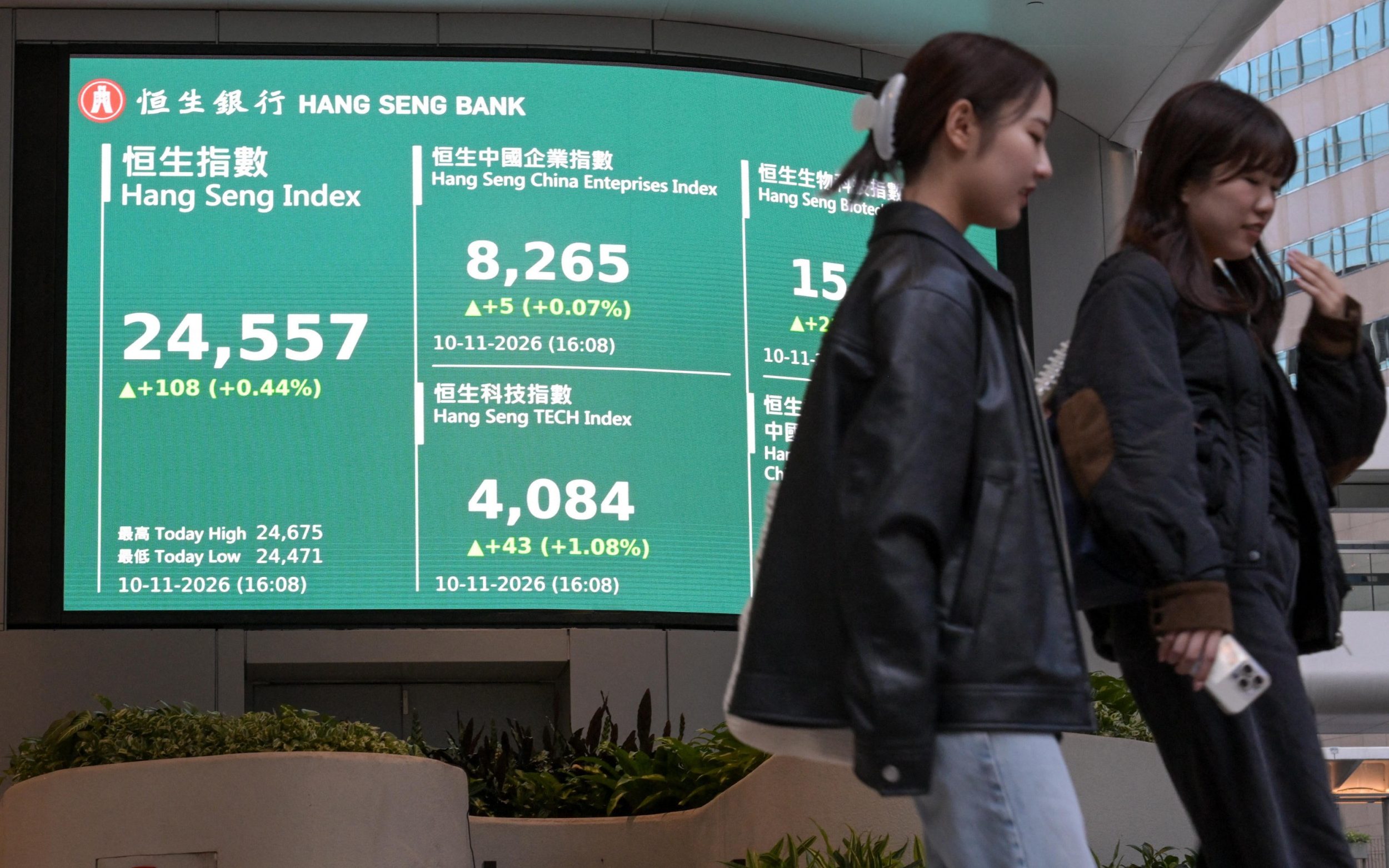
China’s stock market struggled as Nvidia ousted Jensen Huang - Sipa/Alamy
When news of Jensen Huang’s exit from Nvidia broke, the shock waves quickly reached China’s stock market.
Shares in Alibaba, the tech giant, dropped more than 6pc on Thursday after the Nvidia boss resigned. The company has been named as the biggest customer of Megaspeed, the Singapore tech company where Alice Huang, an alleged Chinese spy who had an affair with Mr Huang, was an executive.
Elsewhere, shares in Z.ai and MiniMax, two Chinese AI developers, fell 9pc and 7.8pc respectively on concerns that the scandal will make it harder for China to get hold of advanced microchips.
The CSI 300 in Shanghai, considered China’s blue-chip stock index, fell by 0.9pc last week, while the Hang Seng in Hong Kong was down 3.5pc.
While it might seem like China’s AI bubble is beginning to burst, in fact, it never inflated. Chinese stocks have been in the doldrums even as its tech champions make AI advances and even as the US market booms on the back of the technology. The Nvidia crisis is simply deepening the market’s woes.
“I’ve got a very strong opinion on Chinese equities: nobody makes money from them,” says Peter Kinsella, the head of investment services at Swiss private bank Union Bancaire Privée.
The CSI 300 fell 8.5pc in October, marking its worst month in a decade. Mainland China’s growth-oriented ChiNext and Star 50 indexes have fallen into deep corrections, each falling more than 40pc since June.
This has prompted Chinese regulators to tell banks to hold off on new market listings, according to the Financial Times, in an effort to stop flows of capital away from the country’s flagship indexes and into the buzzy new stocks.
“The Chinese do things very differently and prudently, and they think more about the impact on the existing wealth of their people,” says Raymond T Cheng, chief investment officer for North Asia at the FTSE 100 bank Standard Chartered.
Allowing a flood of fast-growing AI companies to list would suck capital away from other businesses as passive funds rebalance their portfolios to take into account the new additions and retail investors chase quick profits.
“That would not only negatively impact all these Chinese investors’ wealth, but also impact the state’s wealth because a lot of these state-owned companies that are included in the indexes have Chinese authorities as the majority shareholder,” says Cheng.
“So they have to do things in a very gradual manner. I’m not saying that they will not include these AI stocks, but I think they are carefully and gradually pacing the inclusion rather than an abrupt move.”
Beyond largely missing out on the AI boom, China’s stock market malaise reflects the lingering effects of a property crash and spendthrift consumers who are doing little to support the real economy.
The CSI 300 has fallen more than 16pc in the last five years. In the same period, the US benchmark S&P 500 has surged 60pc.
Kinsella thinks China’s stock market is a “classic value trap”, a term used by investors for a market that appears cheap and worth buying but continues to decline or stagnate.
Advertisement
Yet it was not always clear that China’s market was destined to decline. Between January 2025 and its peak in June this year, the blue-chip market surged more than 30pc. That rally was driven by the belief that China was about to eat the West’s lunch after the launch of the cut-price AI chatbot DeepSeek, which sent shock waves through Silicon Valley.
Kinsella says one of the main reasons for the recent decline is the fact that China’s stock market is dominated by retail investors – regular people putting money into stocks – rather than institutions.
As a result, there is less liquidity and relatively small changes in the direction of money moving around can trigger bigger swings in price.
“Chinese equities tend to be extremely more volatile than any of their international equivalents, number one,” he says.
“Number two, you’ve got a certain level of political influence, I’d say, in Chinese equities.”
State-backed companies make up more than a third of the value of the country’s stock markets, according to the OECD.
Kinsella adds: “They basically don’t make a lot of money because the competition is so fierce.”
The clearest recent example of this is in the electric vehicles sector, where a vicious price war saw carmakers’ profit margins fall to a record monthly low of 1.8pc in December 2025, according to the China Passenger Car Association. Beijing has since intervened to try and rein in the destructive undercutting on price.
Xiadong Bao, a portfolio manager at Edmond de Rothschild, cites China’s broader economic weaknesses as another factor undermining the stock market.
The country is at risk of a “deflation spiral”, he said, with official figures showing wholesale prices rose in only half of the 30 key sectors tracked by China during October, with the rest recording modest declines. Consumer inflation slowed from 0.9pc to 0.7pc.
Prices are stalling or falling in part because of the country’s substantial industrial capacity, with the country producing more than it can consume in some cases. At the same time, Chinese consumer confidence is deep in pessimistic territory, still scarred from the years-long property crash that has eroded the wealth of many.
Deflation often causes companies to delay investments, which in turn can hurt stock market returns.
Halfway around the world, the unfolding crisis at Nvidia will almost certainly worsen things. Observers believe that scrutiny of Huang’s affair with an alleged Beijing asset will toughen Washington’s approach to China, threatening to deepen economic woes.
For Kinsella, recent circumstances don’t change his overarching opinion: stay out of China.
“If you look at Chinese equities and you compare their performance to anything on the international stage, they dramatically underperform for a very severe period of time.”
Source: “AOL Money”
