


Jensen Huang’s downfall threatens the AI industry built around him
Jensen Huang’s downfall threatens the AI industry built around him

Matthew FieldSun, November 15, 2026 at 12:00 PM UTC
0
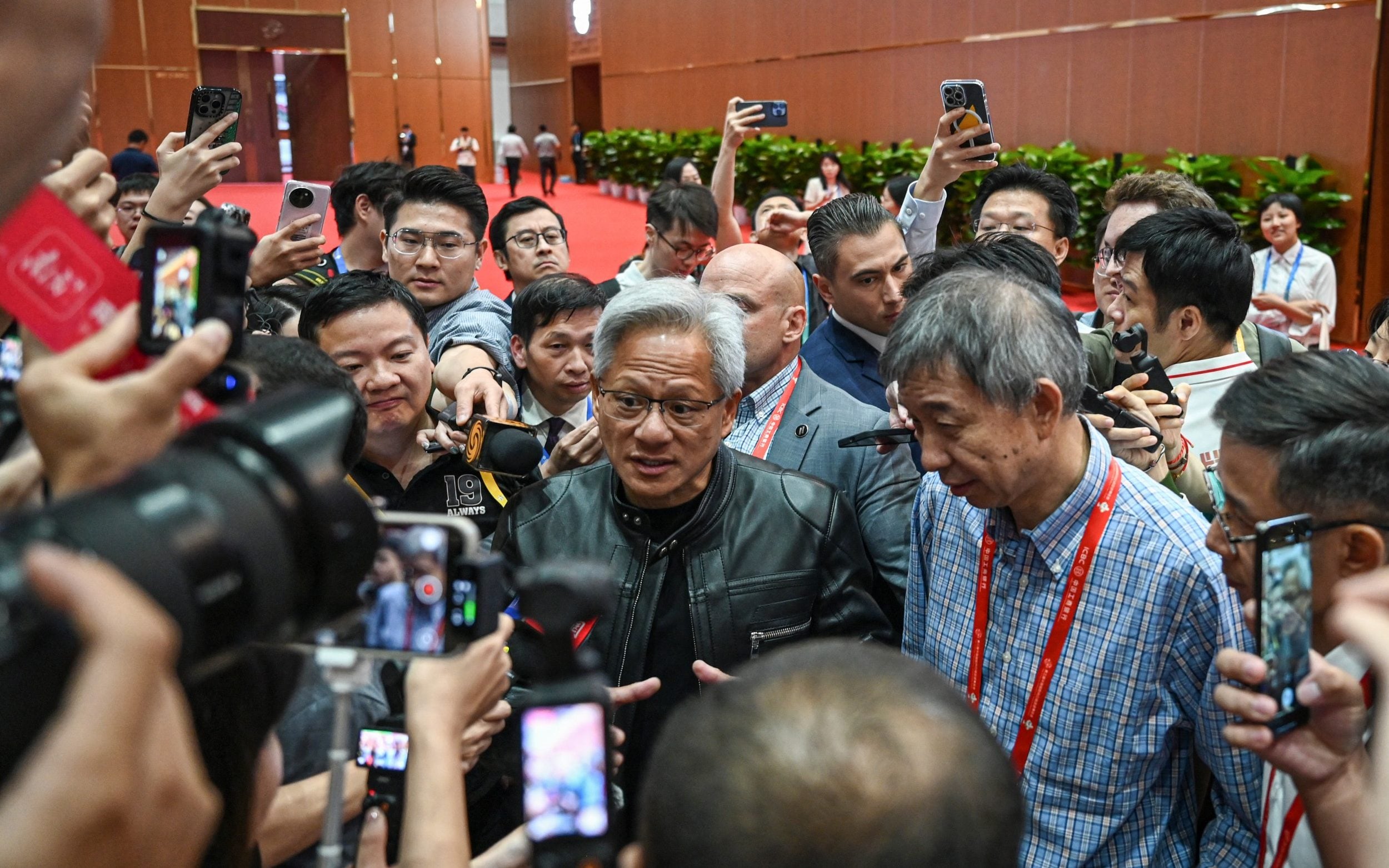
Reports of two affairs, including with an alleged Chinese spy, led to Jensen Huang’s ousting as Nvidia’s chief executive - AFP/Jade Gao
At a glitzy tech event in Mayfair last month, Jensen Huang held court and channelled Oprah Winfrey’s notable “you get a car” giveaway as he bestowed gifts upon his adoring followers.
“I’m gonna invest in you,” the Nvidia chief said, pointing to the crowd. “I’m gonna invest in you, I’m gonna invest in you.”
“Last year you were zero,” he added, gesturing to the boss of Nscale, an artificial intelligence (AI) data centre company backed by Nvidia. “Now look at them.”
Huang, with his rock star’s leather jacket and sharp wit, has been called the godfather of the AI revolution thanks to his role in creating the chips that power the transformative technology.
But he and Nvidia have also earned another nickname: AI’s central banker.
As well as being the most important supplier to the AI boom, Nvidia is a key financial backer to many players in the market.
The total value of its equity investments has soared from about $2bn (£1.5bn) two years ago to more than $99bn as of its last financial results. Since then, it has committed a further $10bn to Anthropic’s upcoming float.
Nvidia has also served as a financial backstop to many billions in data centre deals, providing guarantees that have helped developers secure financing.
These decisions have chiefly been driven by Huang himself. He has helped plan and promote a series of transactions raising many billions for his own customers, often via complex funding arrangements.
Huang’s sudden downfall last week therefore raises questions for the dozens of companies that have enjoyed Nvidia’s benevolence, and casts doubts over the sustainability of an AI boom the company has helped create.
Even among the big characters of Silicon Valley, Huang was known as a domineering and forceful leader.
“Few CEOs have vision,” says one former executive at a rival. “He does.”
More than a decade ago, Huang calculated that Nvidia’s gaming chips could be useful for powering AI and made a big bet to switch from serving the video game market to focusing on AI.
The bet has paid off handsomely. Since the launch of ChatGPT in 2022, Nvidia’s stock is up about 1,000pc and at one point became the world’s first $5tn company. Huang, 63, has also risen to superstardom. In Taiwan, where he was born, the chief executive is often flocked by fans in a trend dubbed “Jensanity”.
Nvidia’s most recent systems, giant server racks made up of thousands of processors, have been used en masse in AI data centres around the world.
Huang’s bet was that investing in and backstopping AI and data centre companies would help to grow the market for its chips, with demand for the AI services they would power following in time.
The Nvidia boss has been instrumental in pursuing this strategy. He led via an unusually flat management structure, with some 60 executives reporting to him directly. He was also notorious for his ability to deliver a furious dressing-down for staff he felt were failing to deliver.
“The company is run like a kingdom,” wrote industry analysts SemiAnalysis last week, adding that few of Huang’s top executives could “do things without Jensen”.
Nvidia quickly became a key supplier to the data centres of tech giants such as Microsoft and Google. As its success and its finances grew, the company moved from supplying AI chips to being a key financier helping a new wave of customers afford them.
Advertisement
One reason for this push was to build a loyal base of data centre customers and head off the risk that its big tech clients would one day create their own rival systems.
In 2023, Nvidia became an early investor in Coreweave, a “neocloud” data centre operator. In 2025, it stepped in with $250m to prop up Coreweave’s initial public offering after demand from investors faltered.
Last year, it also invested in Nscale, a UK data centre operator, and provided an $860m guarantee for one of its biggest planned facilities. At the time, Huang told UK reporters that he was the “best thing that’s ever happened” to Josh Payne, Nscale’s chief executive.
The company also expanded aggressively with customers in South East Asia. These included Megaspeed, which ordered billions of Nvidia’s chips.
But the deals also prompted concerns that China was using these customers to gain access to its cutting-edge systems, circumventing US export controls. Revelations of Huang’s affair with Alice Huang, a senior Megaspeed executive and an alleged Chinese spy, ultimately proved to be his undoing.
In recent months, the pace of Nvidia’s deals accelerated. According to SemiAnalysis, as of July, this included some $530bn of “off-balance sheet” commitments, up from $184bn months earlier, made up of various backstop arrangements, cloud deals and other investments.
Even before his ignominious exit, questions were mounting over Nvidia’s flurry of so-called circular transactions – where Nvidia gives a company money to buy its products – and some of its more convoluted financial promises.
In August, Huang announced plans for $500bn in deals with Wall Street giants including Apollo, BlackRock, Blackstone, Brookfield, Goldman Sachs and KKR, claiming that AI computing would become an “investable asset class” and that “in AI, compute is revenue”. He dismissed claims of circular financing.
Yet so far, none of these deals has materialised. According to Bloomberg, Nvidia’s customers had been calling for the company to increase the size of financial backstops it provided. Nvidia has agreed to guarantee about 25pc of the value of the deals.
The appointment of Colette Kress, Nvidia’s finance chief, as interim chief executive has fuelled speculation that Nvidia’s profligate dealmaking could slow.
The Telegraph understood Kress had clashed with Huang over his seismic AI investments. The Wall Street Journal reported Huang had castigated her over one presentation about the deals earlier this summer, calling her a “deer in the headlights”.
Publicly, Kress has backed Huang’s strategy. In August, she said: “Some will call this circular financing. We see it differently ... the equity returns on our invested capital will be excellent.”
Kress may not be Nvidia’s chief for long. On Friday, the Financial Times reported that Nvidia had approached Arm boss Rene Haas as a potential successor for Huang. But whoever the company turns to as a long-term solution, it is not clear that they will continue the largesse practised by Huang.
Shares in the biggest “hyperscalers”, such as Alphabet, Amazon and Microsoft, have been steady since the scandal emerged. All three are developing their own AI chips. If Nvidia weakens, they could benefit.
On the other hand, newer data centre operators that have been funded by Nvidia have suffered. Shares in Nebius, a European data centre provider backed by Nvidia with $2bn, are down 18pc since Huang’s resignation announcement. Shares in Iren, another data centre company, were down about 7pc.
One technology industry veteran said Huang had been “leaning into the ‘neoclouds’ as another source of revenue that allows Nvidia to diversify”.
They added: “That changes without him as the spider in the middle of that web. You could see more realism in the funding for the neoclouds and the hyperscalers taking back a bit more control.”
Other companies that relied on Nvidia are facing crucial decisions. Nscale, which is heavily backed by Nvidia, said on Thursday that it would need to raise more cash in the coming months as executives consider whether to delay a $35bn float.
An entire new industry owes its rise in part to Huang’s largesse. The question now is whether these businesses can sustain themselves without the godfather of AI at their back.
Source: “AOL Money”
