


The Story Behind Peggy Scott’s Wedding Dress
The Story Behind Peggy Scott’s Wedding Dress

Kaitlyn GreenidgeMon, November 16, 2026 at 3:00 AM UTC
0
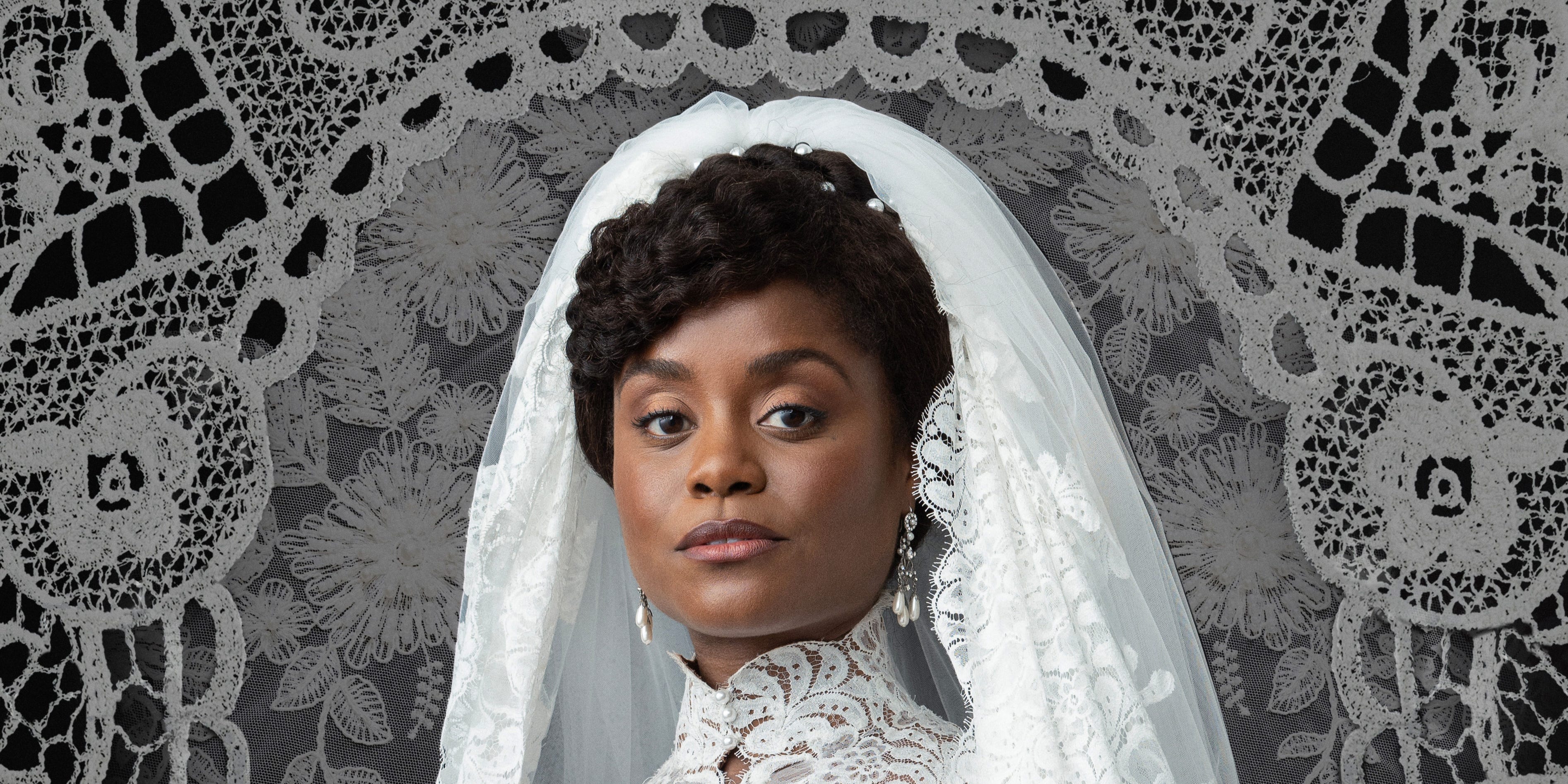
Peggy Scott’s “Gilded Age” Wedding DressThe Tyler Twins - HBO
"Hearst Magazines and AOL may earn commission or revenue on some items through these links."
It’s 88 degrees on a humid June day in Troy, New York, and Denée Brenton stands in a local church’s outbuilding, posing in Peggy Scott’s wedding dress, not breaking a sweat.
It has been a long, hot day of filming, and the cast and crew are scheduled to keep going for many more hours. To get to this photo shoot, I had to walk past a cramped church hallway where Cynthia Nixon, Audra McDonald, and John Douglas Thompson sat together in various stages of Gilded Age undress, trading inside jokes. Everyone on set is in a state of elation, both because of the long-planned-for episode featuring the wedding of Peggy and Dr. William Kirkland and because it’s the day of Game 4 of the Knicks’s historic NBA run. A few hours after I leave set, Nixon will post a reel of the cast reacting to the Knicks win in their Gilded Age finery. But even amidst all of this excitement, Brenton in her wedding dress steals the show. Writers, production assistants, costume designers, and even Jordan Donica, who plays Dr. Kirkland, gather to watch the shoot. Brenton, in the middle of it all, is poised in the gown of white lace, a corset underneath, dress lines crisp, makeup unsmudged, a picture of bridal serenity. Later, Kasia Walicka Maimone, the show’s costume designer, will tell me she spied Brenton doing breathing exercises in the church pews, just to maintain her stamina.
Peggy has been a fan favorite since her introduction in the show’s first episode. An ambitious, upper-class Black woman in Gilded Age America, she is an anomaly in period television. Her storyline has introduced viewers to the world of the Black elite, a burgeoning class that emerged during Reconstruction and would dominate Black political and cultural life to the present day. Popular nonfiction books like Our Kind of People have documented the history of this group, but they have been largely absent from television. Even Black weddings, of any time period, are rarely portrayed on American TV. So how do you design a dress for a wedding that hasn’t been seen before?
“The Gilded Age,” as the period between the 1870s and 1890s is known, “was famous for its excitement [around fashion],” says Walicka Maimone. “How do we represent this excitement? How do we pull out from the historical research things that we, the modern audience, are going to be excited about? We have this giant library of about 50 to 60,000 images that we’ve collected since season 1 … but there’s always manipulation that I apply to it.” Peggy’s wedding dress “resonates with a lot of elements from the period, but it’s not a direct quote of any one specific dress.…What was really important to both Denée and me was the composite of the silhouette [and] the texture of the lace,” a detail that was “referred to in the script directly by her mother-in-law.”
“The speed that we had to accomplish the design and execution and put it on the screen was astronomical,” Walicka Maimone says. “Hundreds of hands altogether contribute to the making. Each dress takes about six to eight weeks to be built.” Those working on the final bridal look included the in-house costume-design team, milliners for the veil and hat, a jeweler in Rome who designed Peggy’s earrings, and on-set tailors who maintained the costume during filming.
“My wedding dress had over 75 buttons going down the back. Amber, my head dresser, buttoned each one by hand. The craftsmanship was really unbelievable,” Brenton tells me a few months later. “It felt powerful to me, spiritually. It felt like we were embodying a moment for a lot of people. I have never seen a luxury Black wedding of the 1800s on any screen, on a stage, in any popular media. And so it really feels like we’re getting to be a part of a pop-culture history moment.”
Peggy is a child of post-Reconstruction America. Her father, Arthur, experienced enslavement, but she is part of the first generation of Black people born into freedom and citizenship. The thrill of watching her on screen is seeing a character who relishes pushing against the boundaries of what that might mean. She is both an avatar of modern viewers’ desires and a fantasy of what Black womanhood might have looked like in a time of dynamic social change and fabulous dressing. For Peggy, the question of a wedding and marriage takes on additional significance.
Advertisement
“Because the law of the land during enslavement recognized enslaved people as property, [and] therefore not protected by the law, nor were there unions, whether they were chosen unions or forced unions … they could be separated at any moment. The law did not protect the sanctity of marriage for Black people, for enslaved people,” explains historian Erica Armstrong Dunbar, who is chair of the African-American Studies department at Emory University, in addition to a consultant on The Gilded Age.
Marriage for the Gilded Age generation of Black people was an assertion of agency and an act of claiming Black humanity. The ability to choose partners and form Black families—and have those family bonds legally protected—was a radical act in the aftermath of slavery. All of this history can inform the context of Peggy Scott’s marriage, but what that wedding might look like on screen is another question.
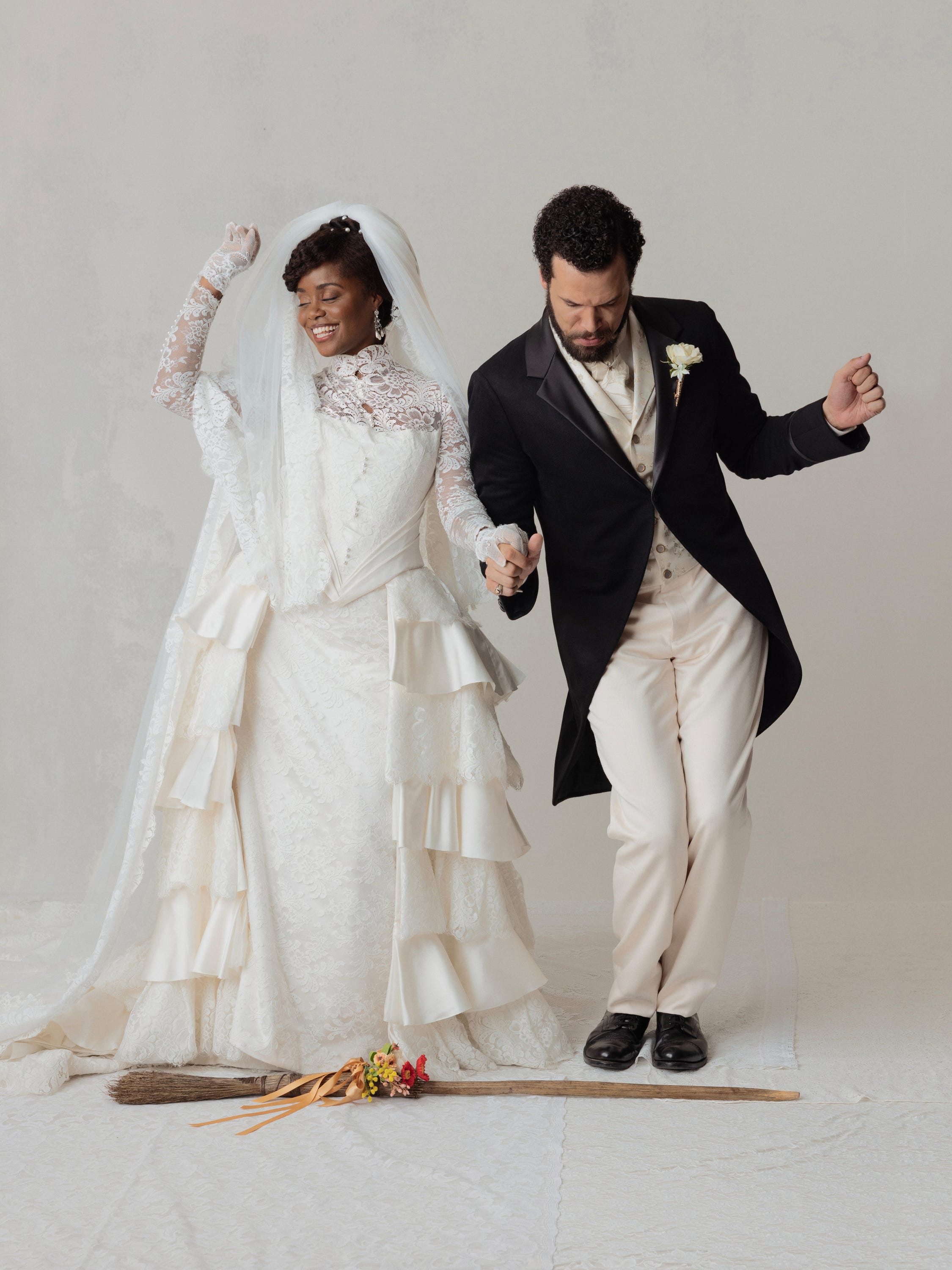
Denée Brenton and Jordan DonicaThe Tyler Twins - HBO
“When we first started talking about the season and the wedding, Sonja Warfield [the episode’s writer] and Julian Fellowes [The Gilded Age’s creator] were very invested in the notion of the jumping of the broom and that being a part of African American wedding tradition,” Armstrong Dunbar explains. Jumping the broom was a wedding tradition practiced by some enslaved people, a ceremonial act to mark a bond that by definition was not legally recognized. “I immediately was like, but that’s not really happening in the 1880s,” Armstrong Dunbar explains. “People were actually distancing themselves from many of the traditional experiences connected to the weddings of enslaved people.” Fellowes, Warfield, and Gilded Age executive producer Salli Richardson-Whitfield and producer Davita Scarlett, however, were all adamant about including this practice in the wedding episode. Many of them had participated in broom-jumping ceremonies in their own weddings; the practice became popular again in the 1970s, ’80s, and ’90s as post–Civil Rights era couples looked to include specifically African American rituals in their wedding ceremonies. But part of the pleasure of The Gilded Age is watching how the show plays with historical conventions and anachronisms to further draw viewers into characters’ lives. In this case, the writers and producers decided to give Peggy’s father, Arthur, who was once enslaved, the task of handing the broom he used in his wedding ceremony to his daughter, a moment that recognizes the family’s beginnings and its triumph of seeing a freeborn daughter legally wed. “It really encapsulated the way in which people try to meld traditions when they’re bringing their families together,” says Scarlett. “It just felt too delicious and too interesting and too thematically rich to pass up.”
“I knew that we were going to be doing Peggy getting married, and I claimed it. I said, ‘No one else is allowed to direct this wedding but me,’ ” says director Richardson-Whitfield. “I just wanted to make sure that it was as lush and gorgeous and special as anything else that we’ve done on the show.” This included the decision to feature a gospel choir. “We specifically chose also to do it a cappella and not have any instruments with the music because I felt like those beautiful Black voices were enough to fill the church,” she says. An a cappella chorus singing spirituals would have been, like the broom jumping, frowned upon by many upper-class Black people in the 1880s, but that tension provided another opportunity to deepen the wedding scenes. “Just because we are African American people doesn’t mean we all think the same thing,” Richardson-Whitfield says. “It’s nice to be able to explore different kinds of Black people.”
The show’s commitment to nuance and its willingness to acknowledge the historical existence of different kinds of marginalized people means its fan base stretches far and wide. Recently, the creative agency Little Big World hosted a Gilded Age drag ball and panel on queer black history with Brenton, activist and Gilded Age fan Brittany Packnett, and queer historian Hugh Ryan. The event was packed. “I think that people see Peggy as this sort of doll princess,” Brenton tells me, “but as the actor playing her … bell hooks has this quote that’s like, ‘Queer not as in who I sleep with, but queer as in at odds with everything around me.’ That is Peggy. Period. There was not really a class of professional women [during the Gilded Age]; you were either aristocracy or you were working class. And then to be a Black professional, she really is one of one moving through this space in her time. And I find that to be very queer.”
“That’s one of the two powers of history work for me,” says Ryan. “One is seeing … ‘Oh, things actually were really different back then. So that means they could be really different in the future.’ And I think that's liberatory. But the other part, and this is where I think The Gilded Age shines … is getting people excited. I was in a panel with 60 Black queer folk in a Black queer space in Bed-Stuy talking about the Gilded Age and Black drag kings in vaudeville. That conversation only happens because beautiful art sparks our interest and allows us to see a place in the past.”
“As an artist, you can’t really ask for more than to do something that is popular and meaningful at the same time,” Brenton says. “The sweet spot.”
You Might Also Like
Grace Jones’s Career in Photos
Michelle Pfeiffer’s Style Evolution Through the Years
Goldie Hawn’s Style Evolution Through the Years
Source: “AOL Entertainment”
